Supplementary website for the paper. Paper (pdf)
Generation Examples
All examples are generated with the model trained on Bach's Chorale Dataset. The only human intervention is the instrumentation/tempo setting for the audio examples. There is no predefined key for each example.
Melody Harmonization
Four-Part Harmonization
Lemoine, Solfeo de los Solfeos 1A No. 106
Molihua
Five-Part Harmonization
Five-part harmonization (although our training set does not include any, our model can have a try).
Bassline Harmonization
In this section, we provide some generation examples on the three basslines provided in our evaluation.
Bassline 1
Example 1
Example 2
Bassline 2
Somewhat chromatic.
Example 1
Example 2
Bassline 3
Highly chromatic.
Example 1
Example 2
Longer Example
On the passacaglia theme used in Pachelbel's Canon in D
Free Generation
Example 1
Example 2
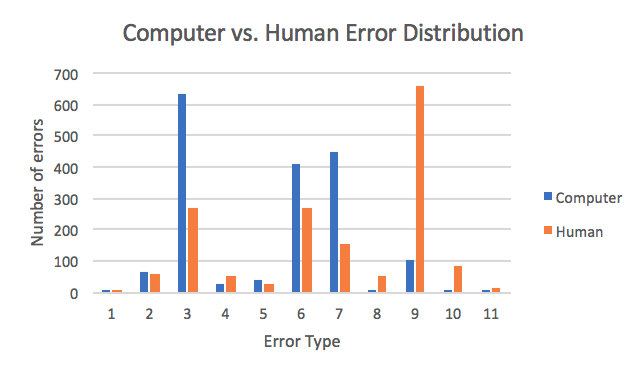
Rubrics for Objective Evaluation
| Type | Explanation | Deduction (pt) |
|---|---|---|
| 1 | Doubled chordal 7th | −1 |
| 2 | Doubled leading tone | −1 |
| 3 | Parallel fifths or octaves between any voices | −1 |
| 4 | Improperly resolved chordal 7th in any voice | −1 |
| 5 | Improperly resolved leading tone in the soprano | −1 |
| 6 | Non-stylistic progression (e.g., I-iii-V), or syntactic error (e.g., V-IV) | −1 |
| 7 | Invalid chord/nontertian chord (e.g., C, C#, E, G) | −1 |
| 8 | Melodic augmented second | −0.5 |
| 9 | Greater than an octave between S and A, or A and T | −0.5 |
| 10 | Voice crossing | −0.5 |
| 11 | Voice overlap | −0.5 |
Error Statistics